
The Short Answer: The Lighting Is Ray Traced, and It Is Not Optional
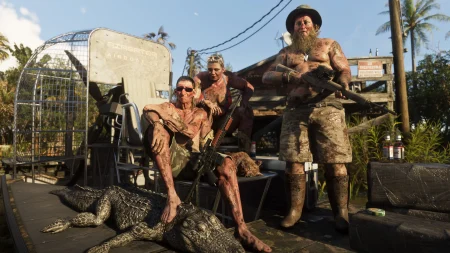
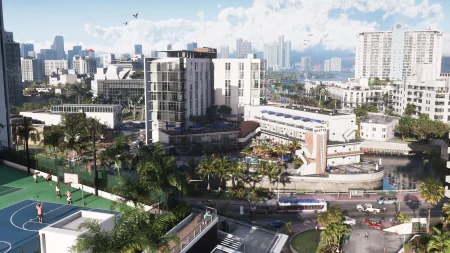
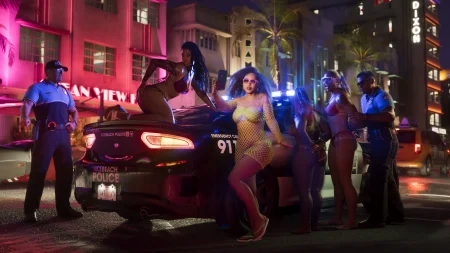
Based on the footage Rockstar has released, GTA 6’s lighting is built on ray tracing. Digital Foundry’s frame-by-frame analysis of Trailer 2 and the Extended Look found ray-traced global illumination and ray-traced reflections running through almost every shot.
That footage was captured in-game on a base PlayStation 5, according to Rockstar. Digital Foundry measured an internal resolution around 1440p, reconstructed up to 4K, running at 30 frames per second.
Rockstar itself has published no graphics spec sheet. Everything technical below comes from expert analysis of official footage, labelled as such, not from a Rockstar feature list.
Key Takeaways
- Digital Foundry found ray-traced global illumination and ray-traced reflections throughout the released footage.
- The footage analysed so far runs at 30 frames per second on a base PS5, at roughly 1440p internally.
- Rockstar has never named the engine version. “RAGE 9” is a fan label, not an official one.
- Hair, skin and fabric rendering are a clear generational step up from GTA 5, per analyst breakdowns.
- No 60 FPS mode, PC version or ray tracing settings menu has been confirmed by Rockstar.
1. The Engine Underneath: RAGE, Evolved
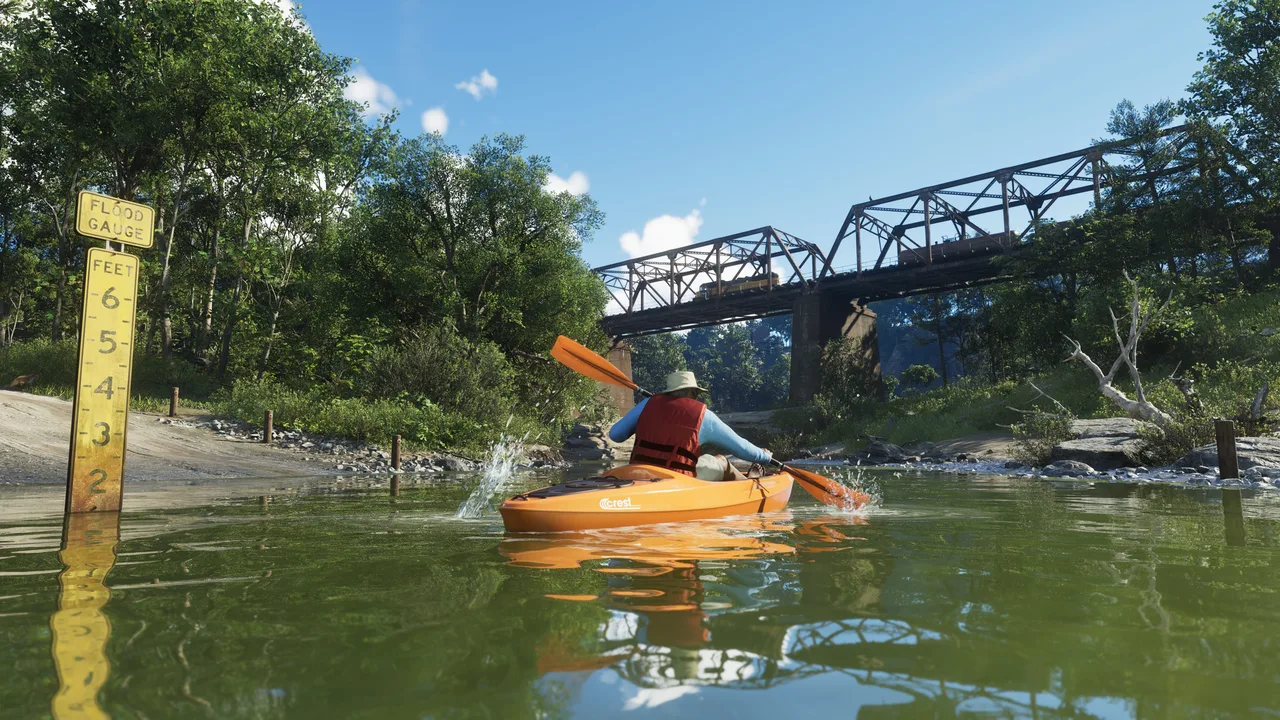
GTA 6 runs on RAGE, the Rockstar Advanced Game Engine, the same in-house technology line behind GTA 5 and Red Dead Redemption 2. Rockstar builds its own engine rather than licensing one, and it does not publish version numbers.
That is why “RAGE 9” should be treated as a community nickname. Fan sites use it as shorthand for the current build, but Rockstar has never called the GTA 6 version RAGE 9 or any other number.
What can be said safely is that the engine has moved on a long way since GTA 5. The newer version already powered Red Dead Redemption 2’s dense natural world, and GTA 6 pushes it into a far busier urban setting.
Rockstar’s silence on engine details is normal for the studio. Almost everything known about GTA 6’s rendering comes from analysts measuring the footage Rockstar chose to release, starting with what GTA 6 Trailer 2 shows.
2. Ray-Traced Global Illumination: The Big Leap
Global illumination is the system that works out how light bounces around a scene. In GTA 5, most of that bounce light was worked out in advance and stored, which is why interiors and shaded streets could look flat when conditions changed.
In GTA 6, Digital Foundry’s analysis found the bounce light is ray traced in real time. Sunlight and skylight enter rooms, spill across floors and pick up colour from nearby surfaces, a behaviour analysts call colour bleeding.
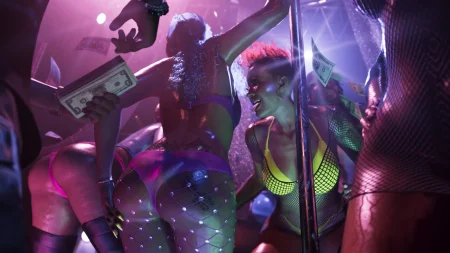
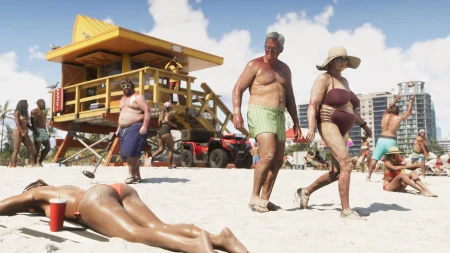
The practical result is that a Vice City alley at sunset, a neon-lit club and a swamp at noon are all lit by the same live simulation. Nothing needs to be pre-baked for a specific time of day.
Alex Battaglia of Digital Foundry made the strongest version of this point: the ray-traced global illumination cannot simply be switched off for speed, because it is inherent to the way the game renders. The lighting is the look.
3. Ray-Traced Reflections: Mirrors, Sunglasses and Wet Streets
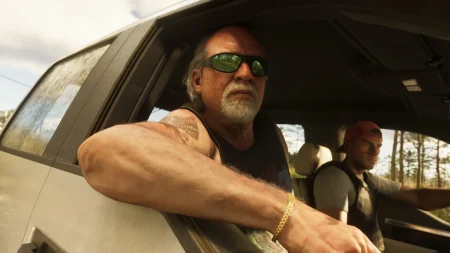
Reflections are the second confirmed pillar. Analysts found true ray-traced reflections on car mirrors, windscreens, sunglasses, glass storefronts and wet roads across the released footage.
The detail that convinced Digital Foundry is that characters themselves appear in reflections. Older techniques, such as screen-space reflections, can only reflect what is already visible on screen, so a person standing behind the camera would simply vanish from a mirror.
GTA 6’s reflections do not have that limit, which points to a proper ray-traced solution. A shot of Jason driving shows several reflective surfaces at once, each returning a different, correct angle of the world.
On rougher surfaces, analysts saw the ray-traced result blended with cheaper screen-space information, and the ocean can look noisy in motion. Those are the expected compromises of running this on console hardware, not signs the effect is faked.
4. Shadows, Hair and Fabric: The Supporting Cast
Not everything is ray traced, and that matters for honesty. Digital Foundry’s Extended Look analysis found that sun and local shadows still rely on highly refined shadow maps, with softer edges that spread realistically with distance.
Ray-traced shadows may appear in limited places, but the analysts’ read was that Rockstar improved its traditional shadow technology rather than replacing it wholesale. Claims that every shadow in GTA 6 is ray traced go beyond the evidence.
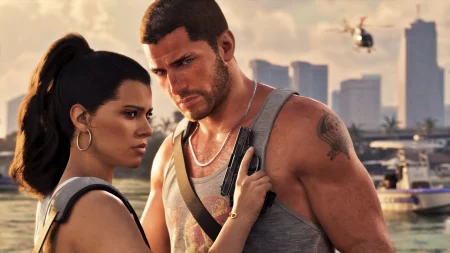
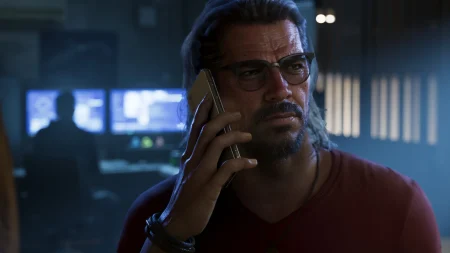
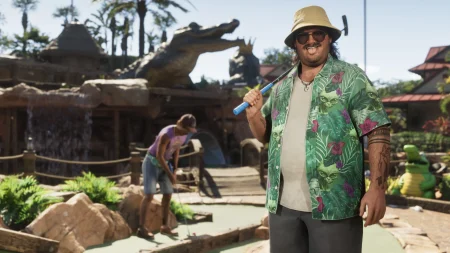
Character rendering drew the strongest praise. Hair is simulated at strand level, with straight, wavy and curly hair all moving with secondary motion and reacting to light properly, a huge step from GTA 5’s sculpted hair.
Fabric and skin received similar attention, with light passing subtly through translucent materials. It is the kind of detail that sells close-up cutscenes, and the trailers lean on it heavily.
5. Resolution and Frame Rate in the Footage
Every piece of official footage analysed so far targets 30 frames per second. Digital Foundry’s pixel counts on Trailer 2 landed around 1440p internally, with one breakdown measuring 2560 by 1152 inside the letterboxed frame, then reconstructed up to a 4K output.
The Extended Look, released in August 2026, told the same story: roughly 1440p, a solid 30 frames per second, captured on a standard PS5 rather than the Pro model.
That combination is a deliberate trade. Doubling the frame rate would mean cutting the resolution or the ray-traced lighting, and the lighting is what makes the game look the way it does.
Whether a performance mode exists at launch is a separate question, and Rockstar has not answered it. Our breakdown of whether GTA 6 runs at 60 FPS tracks everything said on the record so far.
6. How This Compares With GTA 5
GTA 5 was built for the PlayStation 3 and Xbox 360 era, then improved in later re-releases. Its Enhanced editions eventually added ray-traced reflections and lighting features on newer hardware, years after the original launch.
GTA 6 inverts that order. Ray tracing is not a bonus mode bolted on afterwards; it is the foundation the whole image is built on, designed for the PS5 and Xbox Series X|S from day one.
The gap shows most in indirect light. GTA 5’s world often looks lit in patches, while GTA 6’s footage holds together in shade, indoors and at night, because the same simulation handles all of it.
Character detail is the other obvious jump. Strand hair, more convincing skin and cloth that catches light properly put GTA 6’s cast a full generation beyond GTA 5’s models, even the enhanced ones.
7. The PS5 Pro Question
The PS5 Pro has a stronger GPU, faster ray tracing hardware and Sony’s PSSR upscaling, so it is natural to ask whether GTA 6 will look better on it. As of writing, Rockstar has announced no Pro-specific graphics mode for the game.
Every trailer and the Extended Look were captured on a base PS5. That is the reference version Rockstar wants judged, and it already looks the way it does without any Pro hardware.
A Pro enhancement could still be announced closer to launch, and the hardware headroom exists. Until Rockstar says something, any specific Pro resolution or frame rate claim is speculation, including ours if we made one.
Our separate guide to how GTA 6 runs on PS5 Pro collects what is confirmed about the Pro version and what is still guesswork.
8. What Is Not Confirmed
Rockstar has not published an official list of ray tracing features. The findings above are expert analysis of released footage, which is strong evidence, but they are still analysis rather than a spec sheet.
There are no confirmed graphics settings to toggle. Nobody outside Rockstar knows whether the final game offers quality and performance modes, a ray tracing switch, or neither.
Digital Foundry also raised an open question about HDR in the launch trailer, suggesting the tone mapping looked closer to an SDR-style presentation. That is an analyst’s observation from compressed video, not a confirmed problem, and it is worth checking again at launch.
Finally, there is no announced PC version, so every claim about PC ray tracing settings, path tracing or ultra presets is invented. If a PC version is ever announced, its features will be news then, not before.
Frequently Asked Questions
Does GTA 6 use ray tracing?
Yes, based on expert analysis of official footage. Digital Foundry found ray-traced global illumination and ray-traced reflections throughout Trailer 2 and the Extended Look. Rockstar has not published its own feature list, so the confirmation comes from analysis rather than a spec sheet.
What engine does GTA 6 run on?
GTA 6 runs on RAGE, Rockstar’s in-house Rockstar Advanced Game Engine, evolved from the versions behind GTA 5 and Red Dead Redemption 2. Rockstar has never given the GTA 6 build a version number.
Is RAGE 9 the official name of GTA 6’s engine?
No. RAGE 9 is a fan nickname used by community sites. Rockstar does not number its engine releases publicly, and it has never used that name for GTA 6.
Is GTA 6 native 4K on PS5?
The analysed footage is not native 4K. Digital Foundry measured an internal resolution around 1440p, reconstructed up to a 4K output on the base PS5. That is a common technique this generation and it keeps the ray-traced lighting affordable.
Can you turn ray tracing off in GTA 6?
Nobody knows yet, because no graphics settings have been shown. Digital Foundry’s view is that the ray-traced global illumination is built into how the game renders, so a simple off switch for the core lighting is unlikely.
Will GTA 6 run at 60 FPS?
No 60 FPS mode has been confirmed. All official footage analysed so far runs at 30 frames per second, and reports from Rockstar’s studio suggest the console versions are targeting 30 during development, with no commitment to a 60 mode.
Does GTA 5 have ray tracing?
The original 2013 release does not. Later Enhanced editions added ray-traced effects on newer hardware, but in GTA 6 the technology is foundational rather than an add-on, which is the real difference.
Will GTA 6 look better on PS5 Pro?
Possibly, but nothing has been announced. The Pro has faster ray tracing hardware and AI upscaling, yet every piece of GTA 6 footage so far was captured on a base PS5, and Rockstar has confirmed no Pro-specific mode.
Does the Xbox Series S version use ray tracing too?
No per-platform graphics breakdown has been published. The Series S is a confirmed launch platform, but Rockstar has not detailed how its version differs visually from the Series X or PS5 versions.
Are the trailers real gameplay graphics?
Rockstar states the trailers and the Extended Look were captured in-game on a PlayStation 5, mixing gameplay and cutscenes. Analysts treat them as genuine engine footage, while noting that trailer shots are chosen to flatter the game.
The Bottom Line
What has been shown is genuinely impressive: ray-traced light and reflections as the foundation, strand-level hair, and a world that holds together at any hour, all running on a standard PS5 at 30 frames per second.
What has not been shown matters just as much. There is no official feature list, no settings menu, no 60 FPS mode and no PC version, and honest coverage should keep those two lists separate until Rockstar speaks.